PRO Supplier

When it comes to irrigating golf courses, most greenkeepers will judge sprinkler performance by eye. If a sprinkler’s throw is reaching the next one, the assumption is often “that’s doing the job.”

Unfortunately, that simple visual check can be misleading. The real measure of irrigation quality and the biggest factor affecting turf health and resource efficiency is uniformity. In this article Manager of International Golf Sales for KAR UK & Van Den Borne Wesley Henshaw discusses the importance of irrigation uniformity.
Understanding Irrigation Uniformity – The Key to Healthier, More Sustainable Playing Surfaces
What is Uniformity and Why Does It Matter?

Uniformity, measured as Distribution Uniformity (DU), describes how evenly water is applied across the irrigated area. A DU of 100% would mean every square metre receives exactly the same amount of water. In reality, factors like wind, pressure variation, nozzle design, and sprinkler layout mean there’s always some variation but the higher the DU, the better.

Low uniformity forces you to run sprinklers longer to ensure the driest spots get enough water. This overwatering of the rest of the area wastes water, increases pumping costs, and can create softer playing conditions, disease risk, and nutrient leaching.

The Common Misunderstanding

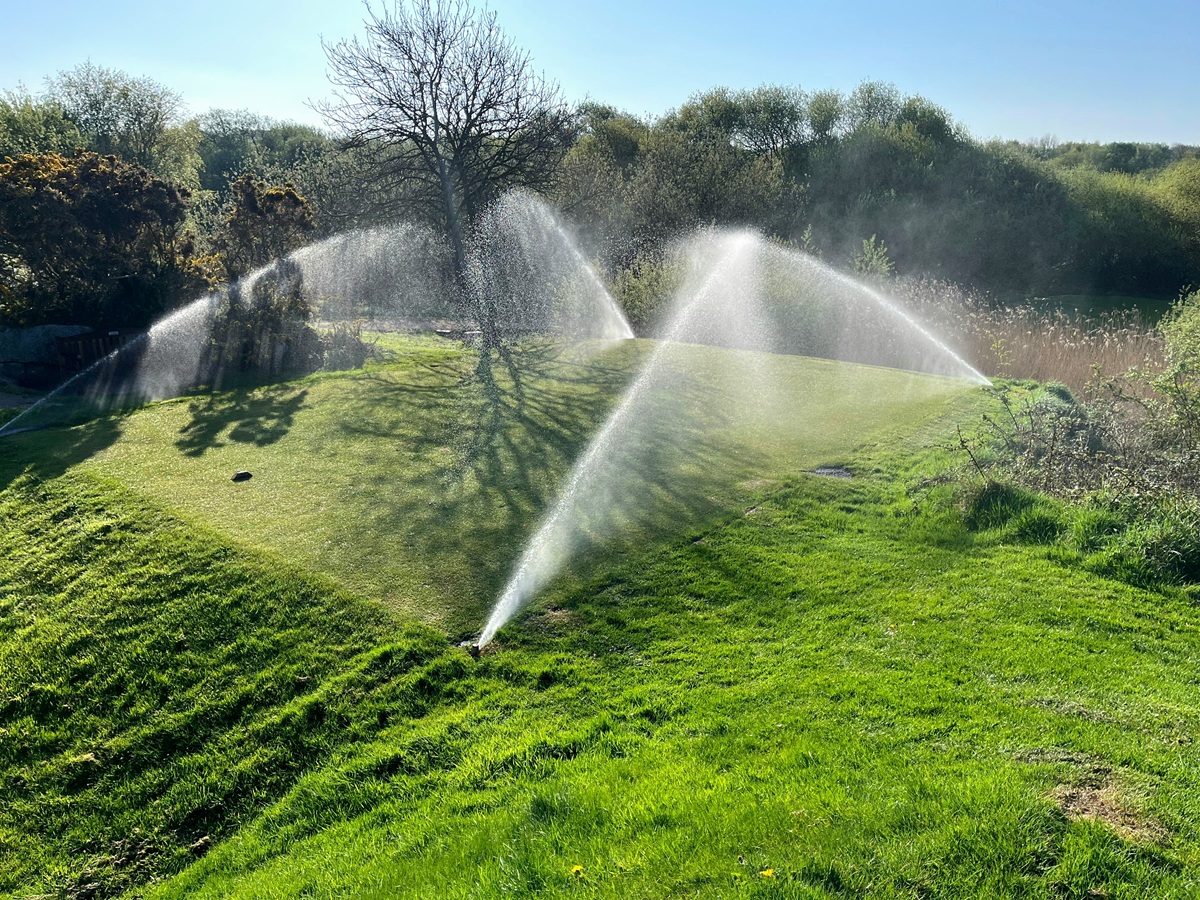
Many believe that sprinkler performance is simply about distance, if one head’s throw reaches another, coverage is “good.” In truth, sprinklers cannot achieve good uniformity if installed in a straight line. Overlapping spray patterns need to be arranged in a square or triangular pattern to blend evenly. Think of it like painting with a spray can, you don’t get a consistent coat by making single passes; you need overlapping passes at the right angles.

Hunter’s Edge: The Highest Uniformity Available

Independent distribution audits have repeatedly shown that the Hunter TTS-800 Series delivers the highest uniformity in the industry, a claim no other brand can make. In real-world UK and international conditions, including challenging wind, these sprinklers have demonstrated massive performance improvements over older systems.

– Example Audit #1 – Greens retrofitted from a competitor’s heads to Hunter’s TTS-800 technology showed DU Lq improving from 48% to 88%, with 26% less run time required. This equated to over 26,000 m³ of water saved annually on just 500 heads.
Beyond water savings, these improvements translated into substantial energy and cost reductions, fewer pumping hours, and more consistent playing conditions.
Understanding Irrigation Uniformity – The Key to Healthier, More Sustainable Playing Surfaces
 Performance Under Pressure – Even in Wind

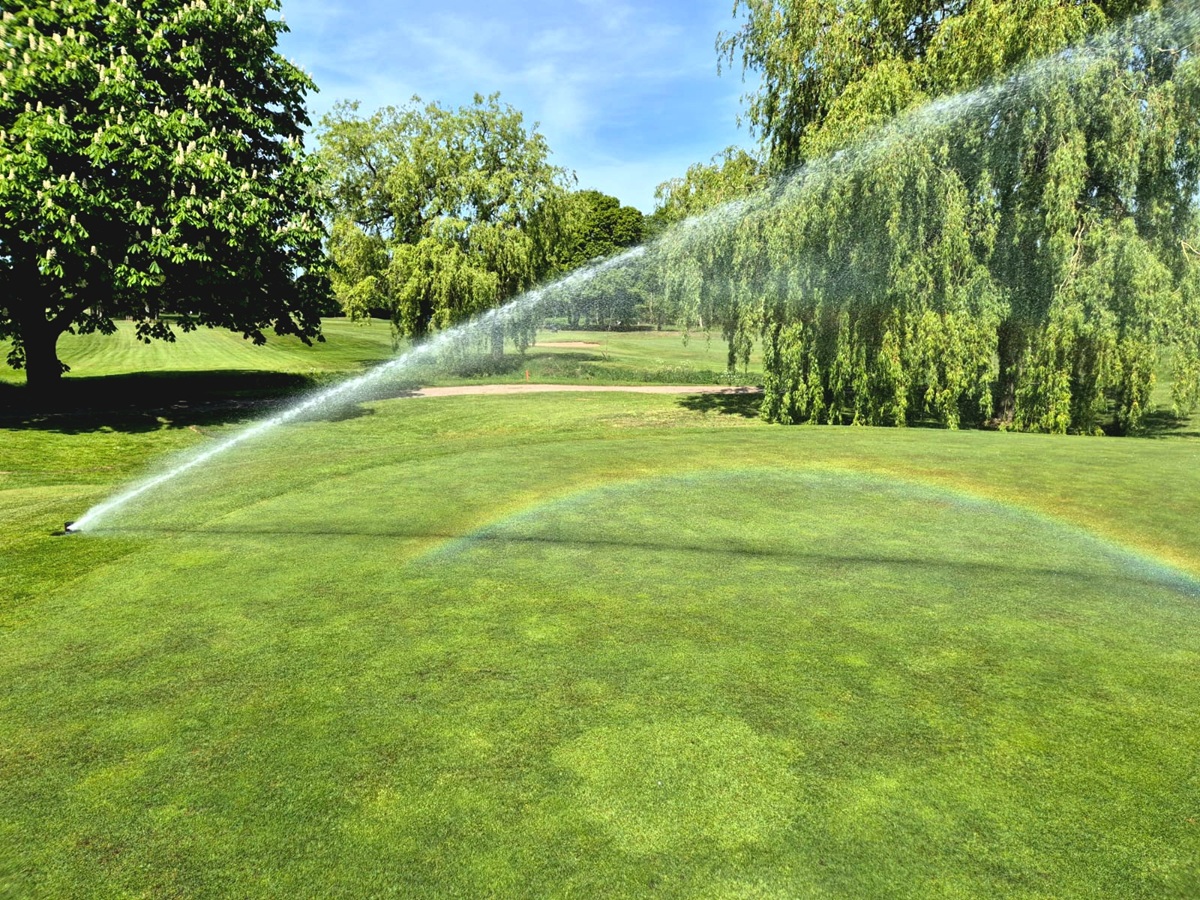
The Hunter G85 Riser is an excellent example of how design drives performance. Distribution testing produces a DU benchmark few can match, especially under windy conditions. The precise nozzle engineering means water is delivered evenly where it’s needed, not lost to drift or overapplication.

How to Check Your Own Uniformity

You don’t have to take anyone’s word for it—checking uniformity is straightforward:
1. Place catch cans evenly across a green in a grid pattern.
2. Run the sprinklers for a set time.
3. Measure the collected water in each can.
4. Calculate the DU Lq (many online calculators can do this with your measurements)

If your DU is below 75%, there’s room for improvement and significant potential savings in both water and money.

The Takeaway for Greenkeepers

Irrigation is not just about getting water from point A to point B; it’s about getting it there evenly. Higher uniformity means healthier turf, better playability, and lower operating costs. With the Hunter TTS-800 Series, you’re investing in the highest uniformity on the market, proven water and energy savings, and robust performance in real UK conditions.

If you’re considering an upgrade or simply want to benchmark your current system, a uniformity test is a great first step. The results might surprise you and could open the door to improved performance and significant resource savings.

For more information, please visit www.karuk.com

Votes: 0
E-mail me when people leave their comments –

You need to be a member of Landscape Juice Network to add comments!

Join Landscape Juice Network

Open forum activity

Jon Chandler replied to Jon Chandler's discussion Growth/Shoots in lawn
"Thanks all for your help and advice.
Great to have the expertise on here as a guide and backup. 🙏"
yesterday
Adam Woods replied to Jon Chandler's discussion Growth/Shoots in lawn
"Others have ID ed it.
I chop them off at ground level with secutears then spray a drop or two of Praxys on the wound... if it doesnt killt he first time, it will the 2nd or 3rd"
yesterday
Fusion Media posted a blog post
At the Portugal Invitational, Kress showed turf professionals that unmanned mowing has moved from emerging concept to practical course-management solutionChampionship golf leaves no room for compromise. That's precisely why Kress chose the inaugural…
yesterday
Neil Darby replied to Jon Chandler's discussion Growth/Shoots in lawn
"If it has thorns it is likely to be a Robinia. I have a client who has a couple of trees 10 or so Metres away & this year they have been popping up all over the lawn. A nightmare tree for anybody who climbs!!!
I have a Gleditsia myself, (my…"
Saturday
Paul Elby replied to Jon Chandler's discussion Growth/Shoots in lawn
"As others have said it is a Gleditsia (honey locust), grows very easily from blown in seeds and suckers. Grows fast in hot dry conditions."
Saturday
Graham Taylor replied to Jon Chandler's discussion Growth/Shoots in lawn
"There will probably be a tree nearby with the same foliage sending out suckers into your lawn.  You could try spraying them with tryclopyr (SBK brushwood killer will do)  ............. tricky as you don't want to risk damaging the tree they are…"
Friday
Kieran Ray replied to Jon Chandler's discussion Growth/Shoots in lawn
"It could definitly be a honey locust sucker but it is more likely to be a Robinina sucker, they can send them up when stressed and ffresh growth can have a purple tinge. "
Aug 18
David Benson replied to Jon Chandler's discussion Growth/Shoots in lawn
"eucalyptus tree suckers i have seen them 60-70 yards from the tree "
Aug 18
John F replied to Jon Chandler's discussion Growth/Shoots in lawn
"Is it growing off a long sucker from a tree in a nearby garden like sumac trees send out ?"
Aug 18
Dave Colton replied to Jon Chandler's discussion Growth/Shoots in lawn
"Looks very much like a locus tree, young ones do also develop spikes."
Aug 18
Fusion Media posted a blog post
For Guy Woodward, Head Groundsman at Warwick Racecourse, maintaining a safe and consistent racing surface is a year-round challenge. From heavy winter rainfall to prolonged dry spells, the demands placed on a jumps track require products that can be…
Aug 18
Jon Chandler posted a discussion
Hi All, In a cleints garden, I'm having a real problem with these shoots that are coming up in the lawn.I'm digging them out as I go, they are on long roots. they have an oval shape leaf and develop nasty thorns. See pics.Can anyone help identify…
Aug 18
Billybop replied to Graham Mitchell's discussion Gardening & Landscaping Recruitment
"yes I would say to be able to start up a fledgling garden service nowadays, you really need to be in a fairly privileged position to be able to build it up, as your initial earnings won't even touch the sides of the cost of living, let alone the…"
Aug 18
Jon Goves updated their profile
Aug 18
Honey Badger replied to Graham Mitchell's discussion Gardening & Landscaping Recruitment
"As mentioned they are demotivated because of the high cost of living and low wages in comparison.
Yes there's is opportunities they have to fight for them because there is alot of competition.
The entitlement and benfit culture is another different…"
Aug 18
Adam Woods replied to Graham Mitchell's discussion Gardening & Landscaping Recruitment
"Agreed 110% Peter.
That said there are exceptions - you just have to find them"
Aug 18
More…

Growth/Shoots in lawn

Hi All, In a cleints garden, I'm having a real problem with these shoots that are coming up in the lawn.I'm digging them out as I go, they are on long roots. they have an oval shape leaf and develop nasty thorns. See pics.Can anyone help identify…

Read more…
9 Replies · Reply by Jon Chandler yesterday
Views: 313