Is your lawn weedy, mossy, baldy or just plain tired looking? In this blog we’ll show you how to revive your worn out lawn and make your neighbours turn green with envy.
Ireland is one of the best countries in the whole world for grass to grow in. We have a mild climate, plenty of rain and strong soils. Everything grass needs to thrive. Having said that, growing grass in a lawn is different to growing it in a field or at the side of the road. We’re asking a lot from it. We stomp all over it, we mow it when it tries to grow and we do tend to ignore its needs. If we took the same attitude with our food crops – we’d be pretty hungry.
So it’s no surprise that from time to time, a lawn starts to look tired. The good news is, with the right expertise and the right timing, it’s perfectly possible to revive a worn out lawn.
 https://www.premierlawnsni.co.uk/wp-content/uploads/2018/02/Newtownabbey_garden-300x225.jpg 300w" alt="beautiful lawn in newtownabbey" width="640" height="480" />
Absolutely no doubt about it. A beautiful lawn, like this one in Newtownabbey, really can add value to a property.
However, beautiful lawns don’t happen by accident. It takes regular TLC and occasional renovation to keep a lawn looking this good.
First, diagnose the problem
I’ve worked on golf courses and domestic lawns for over 25 years. And in that time I’ve seen pretty much every grass-related problem you’ve ever read about.
In my experience, a worn out lawn can be due to one (or a mixture) of these 5 things
- Compacted soil
- Thatch
- Poor Nutrition
- Shade
- Wrong grass wrong place
Any of the above will make it difficult for desirable lawn grasses to thrive. And when the grasses get weak, Mother Nature will send in alternative groundcover plants like moss, dandelions, and plantains.
Let’s look at each problem in turn and I’ll tell you how to fix it.
Soil compaction
Let’s be honest, on the clay soils around Belfast, soil compaction is pretty difficult to avoid. Just walking on your lawn on a damp day can squeeze the soil particles together and close up the tiny air pockets that sustain plant roots.
I see soil compaction as a positive thing – it means you’ve enjoyed your lawn. And, with the right equipment, it’s easily remedied.
Aeration is the lawn expert’s favourite technique for relieving compaction. Small cylinders of soil are removed from the top 10cm of the lawn. Hollow-tine aeration leaves little perforations all over the surface so that air, water and nutrients can be reach the roots.
Some people recommend using a garden fork and I have seen some spiked sandals for sale supposedly for lawn aeration. Personally I’m not a fan of either method, I think they compact the sides of the hole they’re making – which is unhelpful. Better to hire a machine and an operator and get the job done properly.
Within a couple of weeks of hollow-tine aeration in the growing season, you’ll see a marked difference in the colour of your grass.
 https://www.premierlawnsni.co.uk/wp-content/uploads/2015/07/aerator-Small-300x169.jpg 300w, https://www.premierlawnsni.co.uk/wp-content/uploads/2015/07/aerator-Small-768x432.jpg 768w" alt="Robbie lynn" width="853" height="480" />
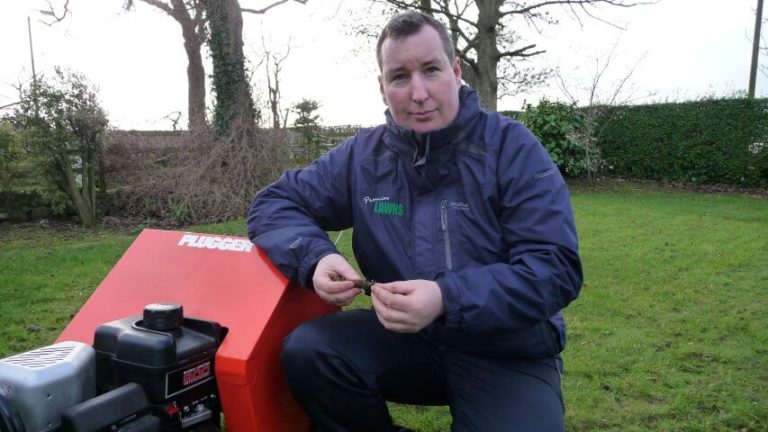
This is a mechanical aerator.
If you look carefully at the lawn behind me, you’ll see where the machine has punched little holes into the soil to relieve soil compaction. I’m holding one of the plugs that have been removed.
Thatch
If you dig out a section of your lawn and look at it side on you’ll see 3 distinct layers. There’s the soil of course, and the grass. Between the two is a brown coloured layer that we lawncare people call “thatch”.
Thatch is a tangle of dead leaves and debris. A nice thin layer is healthy, but if it gets too thick it actually stops water, air and nutrients being absorbed by the soil. In effect, it starves and suffocates the grass. The thatch layer is also thought to harbour the spores of fungal lawn diseases like fusarium and redthread.
Thatch is easily removed by scarification. Now scarification looks brutal. And it removes scary amounts of rubbish leaving the lawn looking (temporarily) quite sorry for itself. I use a machine which basically scratches out all of the moss, dead leaves etc. You could use a spring tine rake to do the same job. Be warned though, it’s harder work and takes longer than you’d think. Great if you want to burn off a lot of calories!
Again, once the lawn has recovered from scarification it’ll be greener, healthier and lovelier than you’ve seen it in a good while.
Poor nutrition
Every living thing needs three things. Air, water and food. If your grass doesn’t have the right nutrients at the right time of year it won’t be healthy. Typically, it will look pale, the sward will be thin and it will be prone to those fungal diseases we’ve already mentioned. Neither will it recover well from wear and tear so you’ll see bare patches.
Poor nutrition is easily rectified – just feed it. But be sure to use the right balance of nutrients otherwise you could make the situation a whole lot worse.
Shade
Shade is the gardeners’ enemy. Grass, like most other green plants, needs light to fuel itself. In low light conditions it becomes pale, weak, spindly and thin. It’s quite common for moss to appear in the shadier parts of a lawn – we’ll talk more about moss in the next blog.
If you can’t solve the shade problem by cutting back hedges etc, there are shade tolerant lawn grasses on the market. Talk to your local lawn care expert about over-seeding and about adapting your lawn care regime to nurture your shaded lawn.
 https://www.premierlawnsni.co.uk/wp-content/uploads/2015/10/1_thick_mat_of_moss-300x225.jpg 300w" alt="thick mat of moss" width="640" height="480" />
Moss is a common problem in lawns but it’s normally a symptom of something else.
You’ll often find moss in shady areas, where soil is compacted or where the grass has been scalped by overenthusiastic mowing.
At Premier Lawns our approach is to treat the moss And address the route cause of the problem.
Wrong grass wrong place
I’m sure you’ve heard the phrase “wrong plant, wrong place”. Well it applies to grass too. There are many different species and varieties of lawn grass. Each has slightly different likes, dislikes, strengths and weaknesses. Most lawns contain a mixture of grass species so that they can meet most of the demands we place upon them. However, if your lawn is based on grasses that don’t cope well with the location or the way you use and maintain your garden, it will struggle. Again, an expert can advise you on the best way to revive and manage such a lawn.
Problem located – now you can build a lawn renovation programme
We’ve looked at the sort of things that can, and frequently do, cause a lawn to struggle. We’ve also looked at possible treatments for each element.
In truth, most worn out lawns I see are cause by at least 3 of those 5 elements. They have thin, pale grass, are infested with moss and weeds and more often than not I can see bare soil too.
Here’s how I tackle a worn out lawn
My Granny used to say “you have to make a mess before you can clear up” and that’s exactly what I do. It’ll be a sorry state for a few days but it won’t take long to recover.
- Scarification: Clear out all the debris so the plants can breathe and we can see exactly what we’re dealing with.
- Aeration: Open up the soil structure and get some oxygen to the roots
- Overseed: If the lawn is very thin I’ll overseed it to boost the plant population. Using the appropriate grass species for your lifestyle and the soil/light conditions
- Feed: Give everything a really good balanced meal and treat any mineral deficiencies at the same time.
- Regular mowing regime: Mowing regularly and at the right height will encourage your lawn to thicken up and grow more vigorously. Many of my clients are happy to do this themselves.
- Follow up feed and weed: 6-8 weeks after the first feed I’ll apply a second treatment, because the lawn will be hungry again. At this stage I’ll also treat any moss or broadleaved weeds that might be trying to sneak back in. If your lawn has been overseeded I’ll avoide using herbicides until the new grass plants are really well established.
Reviving a worn out lawn is hard work but it’s rewarding
I’ll not pretend that lawn renovation is easy. It’s not. Oh it sounds simple when you see it written down, but without the right machinery it can be time consuming and back breaking. Plus, all it takes is a little bit too much fertiliser applied in one go and boom – the whole lawn is burnt to a crisp.
It’s a bit like plumbing or car mechanics – just because you’ve watched a Youtube video and bought the right spanners – doesn’t mean you’ll get it right first time.
Nevertheless, it feels great when you know that your lawn looks so good it’s making passers-by stop and stare and the neighbours are quite jealous. Plus, lawn renovation is usually considerably cheaper that re-turfing.
For expert advice, a FREE independent assessment and some help with the tricky bits – why not give me a call?

Comments